
You passed the eye chart. The optometrist said your vision was 20/20. So why do you still get headaches after an hour on the computer? Why does your child still struggle to track a line of text? Why does walking through a busy store in Surprise leave you feeling dizzy and drained?
Here's what most people in Surprise never hear: 20/20 is a single measurement of how clearly you see a row of black letters on a white chart from exactly 20 feet away. It is one data point. Vision, the actual experience of moving through the world with two eyes and a brain working together, is far more than that.
At Active Eyecare of Surprise, we treat vision the way it actually functions in your life. Dr. Inga Fors, OD, a neuro-optometrist and the owner of our practice, built this clinic around a simple truth: your eyes are an extension of your brain, and how the two work together shapes everything from balance to reading to how you feel at the end of a long day.
What Does 20/20 Vision Actually Mean?
20/20 vision means you can see a specific line of letters on a Snellen chart from 20 feet away. That is the full definition. It does not measure depth perception, eye teaming, focus flexibility, peripheral awareness, contrast sensitivity, or how efficiently your brain processes the images your eyes send it.
According to the American Academy of Ophthalmology, 20/20 is not perfect vision. It is average. Around 35% of adults have 20/20 vision without correction, and some people see better, at 20/15 or 20/10. More importantly, you can have 20/20 acuity and still have real, daily visual problems that a basic eye chart will never catch.
That is the gap we close at our Surprise clinic.
Is 20/20 Vision Perfect?
No. 20/20 vision is a clarity benchmark, not a complete picture of visual health. A person with 20/20 acuity can still have eye teaming disorders, convergence insufficiency, tracking problems, or undetected ocular disease. The eye chart measures one skill. Functional vision uses dozens.
This matters in Surprise because so many patients arrive at Active Eyecare of Surprise after being told elsewhere that their eyes are fine. They are not imagining the strain, the headaches, or the lost place on the page. The test just did not look for what was wrong.
Ready to find out what your eye chart missed? Schedule a comprehensive eye exam at our Surprise office today.
The Visual Skills Your Eye Chart Never Tests
Vision is a team of abilities. When one breaks down, life gets harder even if the chart looks fine. Here are the skills that matter as much as acuity:
Eye teaming (binocular vision). Your two eyes must align and work as one. When they do not, you may see double, lose your place while reading, or feel motion sick in a moving car.
Focus flexibility (accommodation). Shifting focus from a phone screen to a road sign and back takes muscle coordination. Weak accommodation shows up as blurry print, eye fatigue, and headaches.
Tracking. Smooth eye movements keep you following a line of text, a pitched ball, or a conversation partner across a room. Jumpy tracking disrupts reading and sports performance.
Depth perception. This lets you judge stairs, merging traffic on Bell Road, and a coffee cup's exact position. It depends on both eyes working together.
Peripheral awareness. You sense movement and hazards at the edges of your sight without turning your head.
Visual processing. The brain interprets what the eyes send. Slow or faulty processing means a child reads words but does not absorb meaning, or an adult feels overloaded in a grocery store.
Contrast sensitivity. Reading low-contrast print, driving at dusk, or seeing a pale curb against concrete all rely on this skill, and it often declines before acuity does.
None of these is captured by a Snellen chart.
How Are the Eyes Connected to the Brain?
Your eyes do not see. Your brain does. The eyes collect light and convert it into neural signals, and the brain interprets those signals into the experience you call vision. Roughly half of the brain's pathways are involved in some aspect of vision, which is why a concussion, stroke, or developmental delay can disrupt how you see even when the eyes themselves are physically healthy.
The Neuro-Optometric Rehabilitation Association notes that standard eye exams often miss the visual impact of brain injuries, leaving patients told their eyes look fine while they continue to struggle. Dr. Fors built a specialty around this gap.
Patients at Active Eyecare of Surprise who come in after a concussion, a stroke, or years of unexplained visual fatigue often say the same thing: finally, someone looked at how my eyes and brain work together, not just how well I can read a chart.
When Should You See a Neuro-Optometrist in Surprise?
A neuro-optometrist is an optometrist with advanced training in how vision, the brain, and the nervous system interact. You should consider scheduling with Dr. Fors at Active Eyecare of Surprise if you or a family member experiences any of the following:
- Persistent headaches or eye strain after screen work, reading, or driving, even though your acuity is 20/20
- Dizziness, motion sensitivity, or balance problems that do not have a clear medical explanation
- Visual changes after a concussion, stroke, aneurysm, or traumatic brain injury
- Difficulty with reading, attention, or learning in a child, especially one who avoids close work
- Parkinson's disease, multiple sclerosis, or other neurological conditions with visual symptoms
- A feeling that your eyes "don't keep up" in busy environments like crowded stores or highway driving
Dr. Fors specializes in treating patients with stroke, aneurysm, Parkinson's disease, brain injury, and concussion, as well as children with behavioral and developmental disorders. She also sees patients in both English and Spanish, a meaningful detail for the bilingual families who call Surprise and the West Valley home.
Learn more about our vision therapy and neuro-optometric rehab services, or read about Dr. Fors's training and approach on her team page.
What to Expect at a Functional Vision Exam in Surprise
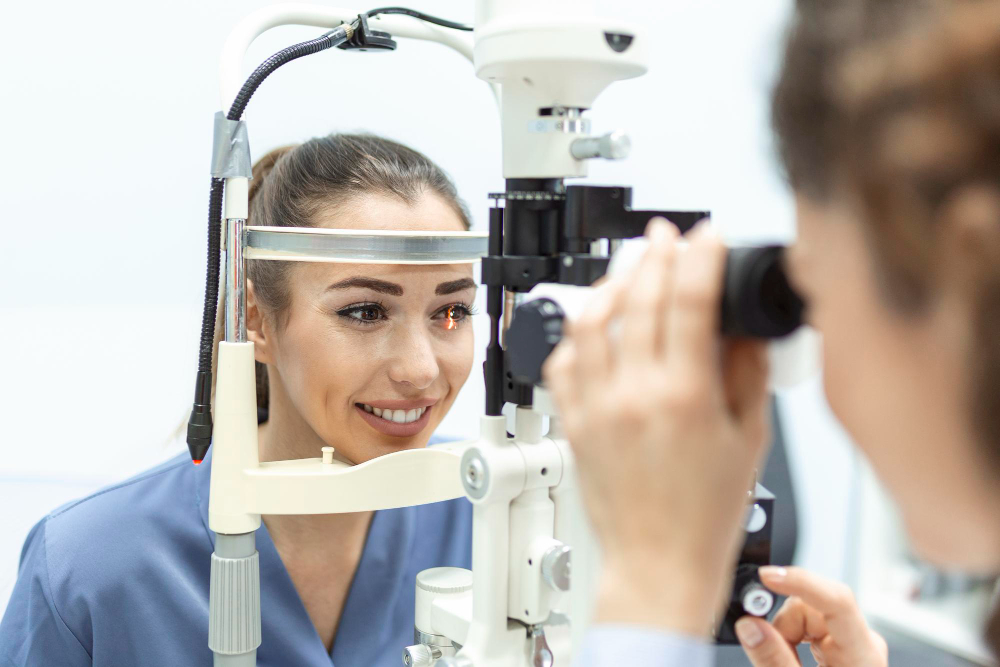
A comprehensive functional exam at Active Eyecare of Surprise goes well beyond the eye chart. Here is how the process typically unfolds at our Bell Road clinic:
- Health and vision history. We take real time to understand your symptoms, neurological history, academic or work demands, and what has not worked in the past.
- Standard acuity and refraction. We still measure 20/20 acuity and your glasses prescription, because this information matters. It is the starting point, not the finish line.
- Ocular health evaluation. Using advanced in-house imaging, we examine the front and back of the eye for disease, retinal changes, and optic nerve health.
- Functional vision testing. We assess eye teaming, focus flexibility, tracking, depth perception, peripheral awareness, and visual processing, the skills that actually drive how you function.
- Neuro-optometric screening when indicated. For patients with brain injury history, balance issues, or unexplained visual symptoms, Dr. Fors conducts specialized testing to map how the visual system and brain are communicating.
- Plan and next steps. You leave with a clear explanation of what was found and a plan, whether that means lenses, prism, vision therapy, co-management with your neurologist, or simply confirming that everything is working well.
You will not feel rushed. That is a deliberate choice at our practice, and it is reflected in our reviews across Surprise and the West Valley.
Call Active Eyecare of Surprise at (623) 214-0353 or book online to schedule your evaluation.
Vision, Balance, and Quality of Life in the West Valley
Clear vision is only one part of the picture. Balance, body awareness, and how you move through space all tie back to the visual system. That is why a patient in Sun City who fell twice last year, or a student in Surprise who cannot sit still during reading, or a retiree in Peoria who no longer feels safe driving at night, may all benefit from the same foundational question: is your brain getting clean, coordinated information from your eyes?
When the answer is no, life shrinks. Tasks you used to do without thinking become exhausting. When the answer becomes yes, patients in Surprise tell us their world expands again.
Active Eyecare of Surprise provides comprehensive eye care and neuro-optometric evaluations in Surprise, AZ, serving families across the West Valley including Sun City, Sun City West, Peoria, and Goodyear.
The Takeaway
20/20 vision means your distance acuity is normal. It does not mean your visual system is working the way it should. Clarity, balance, and the connection between your eyes and your brain together define how you actually see and navigate the world.
If something feels off, even when your last eye exam was called "perfect," trust that feeling. Active Eyecare of Surprise is here to evaluate the full picture. Call us at (623) 214-0353 or visit us at 16968 W Bell Rd, Suite 402 in Surprise, AZ to schedule with Dr. Inga Fors, OD and our team.
Your vision is more than a number on a chart. You deserve care that treats it that way.