

By using our website, you agree to the use of cookies as described in our Cookie Policy
Can Vision Therapy in Surprise Really Help with Reading Skills?
Reading struggles don't always trace back to phonics or comprehension. Sometimes the problem sits behind the eyes — in how they move, focus, and work together. We've seen plenty of kids who can decode words just fine but still lose their place on the page. Adults who reread the same sentence three times before it sticks. That's not laziness. That's often a visual system that isn't pulling its weight.
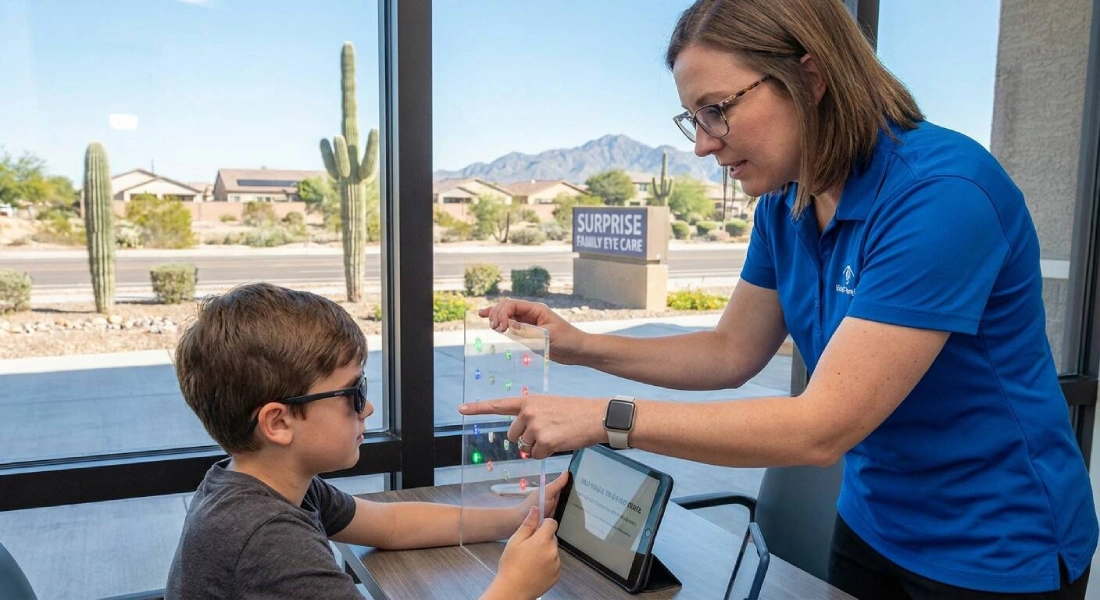
Vision therapy in Surprise has become a go-to for families tired of guessing why reading feels like a slog. But does it actually work? And more importantly, does it work for the kind of reading issues you're dealing with? The answer depends on what's broken — and whether you're willing to put in the reps to fix it.
The Eyes Do More Than See
Most people think vision is about clarity. Can you read the bottom line on the chart? Great, you're good. But reading demands way more than sharp eyesight. Your eyes need to track smoothly across a line of text, jump accurately to the next line, and stay locked on a target without drifting. They need to team up, focus fast, and hold that focus without fatiguing. When any of those skills lag, reading becomes exhausting.
We're talking about functional vision — the mechanics of how your eyes operate under real-world demands. And when those mechanics are off, no amount of tutoring or motivation will make reading feel natural. The brain is working overtime to compensate, and that shows up as avoidance, frustration, or flat-out refusal to pick up a book.
What Breaks Down During Reading
Visual issues that sabotage reading don't always show up on a standard eye exam. You might have 20/20 vision and still struggle because your eyes aren't coordinating properly. These are the usual suspects:
- Eye teaming failures that cause words to blur or double
- Tracking problems that make it hard to stay on the line
- Focus issues that turn every paragraph into a workout
- Visual processing gaps that slow down recognition and recall
- Convergence weakness that makes close-up work uncomfortable
How Vision Therapy Targets the Problem
Vision therapy isn't about glasses. It's about retraining the visual system to do what it should have been doing all along. In Surprise, optometrists who specialize in this work build custom programs based on where the breakdown is happening. You're not just doing random eye exercises — you're drilling specific skills that directly impact reading performance.
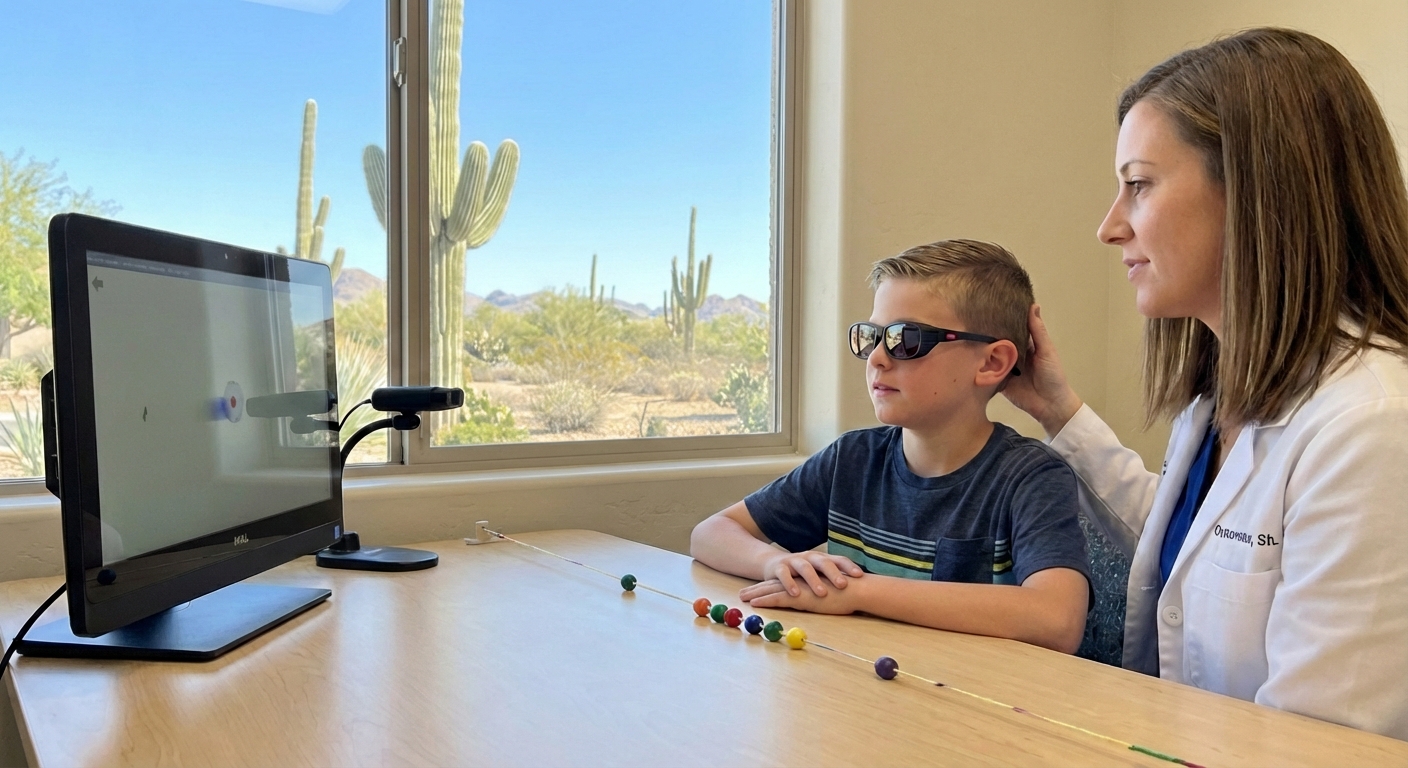
Sessions typically happen in-office once a week, with daily homework in between. The exercises might involve tracking moving targets, focusing on near and far objects in sequence, or using prisms and lenses to challenge eye teaming. It's repetitive. It's structured. And when it's done right, it rewires how the eyes and brain communicate.
Where It Makes the Biggest Difference
Vision therapy shines when the root cause is mechanical. If your eyes aren't teaming, tracking, or focusing efficiently, therapy can build those skills from the ground up. Here's where we see the most traction:
- Kids who skip lines or lose their place constantly
- Readers who complain of headaches or eye strain after a few pages
- Students who avoid homework because it "hurts to read"
- Adults who reread sentences without absorbing the content
- Anyone diagnosed with convergence insufficiency or accommodative dysfunction
What It Won't Fix
Vision therapy isn't a magic bullet. If the reading struggle is rooted in language processing — like dyslexia — then vision therapy alone won't solve it. Dyslexia is about how the brain decodes and interprets language, not how the eyes move. That said, some kids with dyslexia also have visual skill deficits, and addressing those can still make reading less exhausting even if it doesn't cure the underlying disorder.
The key is getting the right diagnosis. A comprehensive eye exam will tell you whether the problem is mechanical, processing-related, or both. If it's not a vision issue, you'll know to look elsewhere. If it is, you've got a clear path forward.
What the Research Actually Says
The American Optometric Association backs vision therapy for conditions like convergence insufficiency, which is one of the most common culprits behind reading fatigue. Studies show measurable improvements in eye teaming, tracking accuracy, and reading endurance after therapy. We're not talking about anecdotal wins — we're talking about controlled trials with objective outcomes.
That doesn't mean every optometrist offers the same quality of care. In Surprise, you'll want someone who specializes in developmental or behavioral optometry, not just someone who prescribes glasses. The difference is night and day.
What to Expect from the Process
Vision therapy isn't a quick fix. Most programs run 12 to 24 weeks, depending on the severity of the issue and how consistently you do the homework. Progress gets tracked with regular assessments, and the exercises evolve as skills improve. Some families see changes in a few weeks. Others take months. Either way, the work is cumulative — skip the homework, and you're just spinning your wheels.
Teachers and parents often notice the shift before the kid does. Less squinting. Fewer complaints. More willingness to read without being nagged. Those are the early wins that signal the system is starting to click.
When to Bring in a Specialist
If reading has been a struggle for months or years, and traditional interventions haven't moved the needle, it's time to rule out vision issues. A standard eye exam won't cut it — you need a functional vision evaluation that tests tracking, teaming, focusing, and processing. That's where you'll get answers.
In Surprise, a handful of optometrists specialize in this kind of assessment. They'll walk you through what's working, what's not, and whether therapy is the right call. If it is, they'll map out a plan. If it's not, they'll point you toward the right resources. Parents in Surprise should know about pediatric vision care options when addressing reading difficulties in children.
Reading Shouldn't Feel Like a Fight
Vision therapy works when the problem is visual. It doesn't work when it's not. That sounds obvious, but plenty of families waste time and money chasing the wrong solution because they never got a proper diagnosis. If your eyes aren't doing their job, no amount of phonics drills or comprehension strategies will make reading feel natural. Fix the mechanics first, and everything else gets easier.
We've guided families through this process enough times to know what separates real progress from wishful thinking. It's not about hoping for a miracle. It's about identifying the weak link and putting in the work to strengthen it. If vision is the issue, neuro-optometric rehabilitation can turn reading from a chore into something that finally clicks.
Let's Make Reading Easier Together
We believe every child and adult deserves to read with confidence and comfort. If reading has become a daily struggle, let's find out if vision therapy is the missing piece. Give us a call at 623-214-0353 to talk with our team, or book an appointment and take the first step toward smoother, more enjoyable reading.
‹ Back
Recent Posts
-

Can Vision Therapy in Surprise Help with Focus & Attention?
September 11, 2026
-

Does Your Child Need Pediatric Eye Care in Surprise?
August 28, 2026
-
Thinking About Switching to Contact Lenses in Surprise?
August 14, 2026
-
Are Headaches a Sign You Need an Eye Exam in Surprise?
July 31, 2026
-
Do You Need a Vision Test in Surprise for DMV Renewal?
July 17, 2026